A child imprisoned in the night stopped breathing expressionlessly.
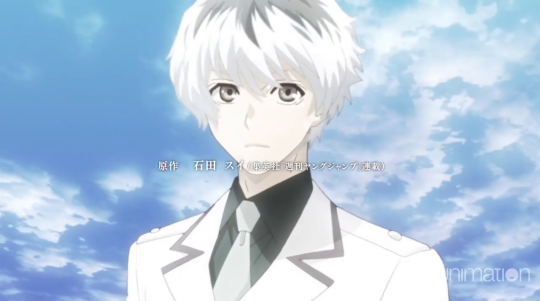
The first series of images presenting the Haise Sasaki standing in front of the blue sky with the rest of the Quinxes overlaying him is a reference to two things in the manga. The first is the caption that the manga opens with.
“The sky next to a tragedy is a clear blue.”
Also the role of the Quinxes. They are all meant to reflect components of Haise’s personality. Individual interpretations vary but generally Saiko is his innocent human self, Urie is the part of him that tries to do everything alone and lashes out, Shirazu is his good natured self that tries to support others, and Mutsuki is his trauma which rendered his original eyepatch self timid and then later unstable.
The next images flash by without any lyrics, showing us both which kakugan eye the quinxes manifest in through darkened silhouette.
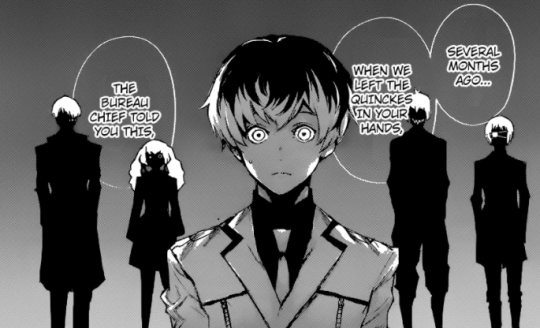
This is a reference to two things, first this panel of the manga where the Quinx are drawn aligned behind Sasaki in the exact same silhouette, but reverse order. (though funimation could have mirrored it).
The second drawing of Sasaki in silhouette is based off of a tendency of Ishida’s to draw Haise in shadowy silhouette except for his ghoul eye when he’s embracing his ghoul side. This is likely an allusion to the jungian concept of the shadow, which Haise tends to interpret his baser more violent subconscious desires with his ghoul side, and his rational conscious thoughts with his human one.
The title text is kept mostly the same from the manga. I assume the emphasis on the red colon is a nod to the fact that the colon before :re one black one red has always been a symbol a one eyed ghoul, as one of the dots is red like a kakugan.
The next few images in sequence are just establishing which side each Quinx manifests their kakugan eye on.
Urie and Saiko’s are on their left like Kaneki, while both Shirazu and Mutsuki have their eyes on the right. There’s not much meaning behind this but it’s interesting to compare. Kaneki and Mutsuki are extremely direct foils both being eyepatch wearing ghouls and they have their kakugan in opposite eyes and therefore their eyepatches on opposite eyes as well. Whereas eventually as squad leader Urie will take Haise’s place and therefore their kakugan eyes are on the same side.
You’re drowning in a world you cannot change
The anime shows Arima directly over this line. It’s more than likely because Arima is the one responsible for Kaneki’s transformation into Haise, and he’s also the stop gap that prevents Haise from regaining his true self.
The quinque he’s holding is Ixa, which is also the quiqnue which Arima finished off Kaneki and stabbed his other eye with. The shattered glass effect right behind where he is holding Ixa is most likely a reference to that. Shattered glass being symbolic for a shattered visual field.
The next image played over the same lyrics is Haise and Kaneki both moving and then reaching in different directions. Kaneki’s is red and black, once again symbolic for the shadow of the subconscious, whereas Haise’s is white and bathed in light. As long as he remains a dove he believes he’ll have conscious control over himself.
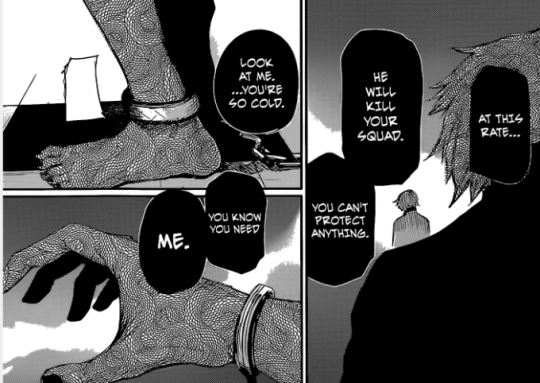
Kaneki’s hand reaching out is a reference to this panel in the manga during the serpent fight. There’s no panel where Haise really reaches out with his hands, but it could be a reference to this moment here. Where he prepares to consciously use his power to combat Seidou and protect Hinami.
because there’s nothing but things that can’t be helped.
This line plays over Juuzou and the rest of his squad which is appropriate because that’s Juuzou’s attitude towards everything.
Juuzou on the rooftop may be a reference to the way he gets rid of his will in both the 20th ward raid arc and the 24th raid arc.
Open your eyes.
This plays over images of Touka, Nishiki, Yomo and Scarecrow which makes sense because all of those are people from Haise’s past who act like the guardians to his true memory.
A sinking shadow.
This lyric playing over Shuu’s appearance could be a reference to his want to bring Kaneki back. Also, his standing on a rooftop facing opposite to Sasaki is a reference to their eventual showdown on top of a tower with the cityscape in the background.
Haise will later on in the opening be shown standing on the exact same helipad which is where his and Shuu’s, as well as his and Kanae’s, and his and Eto’s climactic battle takes place at the end of the Rose arc.
No matter when, this is reality
This is a reference to a manga panel. Hinami only shows one kakugan when she’s using her kagune because she’s thinking of her brother and using them for her sake, thus she shows the same kakugan eye as Kaneki.
The lyrics that play ove this scene may be a reference of Hinami’s acceptance of reality, that Kaneki may have forgotten her but she still wants to protect him.
Alone, I had hoped that the pain experienced by you who is not dead might be love
The quinx flash by using their kagune, the only real substantive image is this one of Mutsuki wearing the eyepatch, which he wears to suppress his true nature but usually falls off when he’s being more genuine.
However, the most significant scene while this set of lyrics is playing is of course the reveal of Furuta’s true nature in the shadow of Kjima.
Unlike Kaneki, or even the Quinx who experience the same effect of the city flashing by, when it flashes behind Furuta’s head the city is dyed blood red. Most likely a symbol of their differing intentions. Sasaki and the Quinx overall genuinely want to protect Tokyo, while Furuta’s ambition is to control the city and dye the streets red with blood (quite literally as we find out later).
The lines “alone I hoped the pain experienced by you might be love” in this context definitely sounds like a reference to Furuta’s one sided love for Rize, who he was separated from and agonized for over the longest time.
Furuta being the only other character as closely tied to Rize as Kaneki, and Kaneki’s true foil and ultimate final antagonist as the one who truly dropped the bars on Rize that night.
The “you who is not dead” may be a reference to the Seidou/Akira/Amon trio who are shown in the next few shots.
Seidou is displayed as looking at the moon and away from both of them. Akira initially looks at Seidou, but then turns around and the screen pans across to follow her gaze to Amon. Seidou also standing on a rooftop is how he was waiting for his fight for Sasaki to begin. Notice the moon clear in the background that’s going to be important for Sasaki’s character later.
Perhaps a small nod to future events, Seidou and Akira are always going in opposite directions whereas Akira and Amon walk the same path. Also maybe a hint to their conflicts, Seidou and Akira are too different and always end up fighting or running away from each other, Akira and Amon are ultimately too alike both loving Mado Sr. and the CCG too much to affect any real change in one another.
“You, who is not dead” is therefore a reference to Seidou and Amon who are both not dead, but also refused to tell Akira they were alive until it was almost too late because they were afraid of being rejected due to being ghouls.
Before that shot we have Mirumo wearing the glasses he wears as a mask as Croquette monsieur. Matsumae is staring at her mask, because later on she will remove the mask before the fight against Hairu as a symbol of her intention to sacrifice herself so Shuu can escape safely.
The roses in the background are a reference to Kanae. Her heart is trapped “in a forest of roses” and it’s also the flashback given as the source for her true affection for Shuu.
Smite me, schaudenfreude is unpleasant.
The clowns standing off against Take’s squad is a reference to their upcoming fight in the auction. Schaudenfreude is a german word for “happiness at the misfortune of others” which is basically the clown philosophy anyway. The shot of Donato immediately afterwards is likely a hint of his association with the clowns.
His eyes shining through the cell an indication that even when restrained and imprisoned, Donato poses a great deal of threat to the investigators interviewing him and trying to keep him contained.
If it’s on purpose, the surprise is frightening. Admire the sound somewhere.
The lyrics are vague here, I’m not going to try to connect them to the images, but we get a shot of all three leaders of the CCG, the Washuu family with a V agent in the background hinting at their true alliance.
If there is a surprise to be found it’s in Eto’s surprise appearance at the end of the Rose arc to fight Haise Sasaki on the rooftop. This transformation right here is a pretty direct reference to a panel of the manga that takes place during their fight.
Finally the opening ends with Haise standing on the same helipad. This time however the moon has gone blood red, and is drenched in shadow.
This is a reference to Haise’s death which takes place on that same helipad at the end of the arc. After fighting Tsukiyama, and Kanae in sucession Eto swoops down and returns Kaneki’s true memories to him causing Haise to fall asleep. The fact that the line is shown tearing through his arm could be a reference to the arm that is lost in that same fight.
It also represents the disconnect between his two selves. As I said above Haise considers his active decision making conscious mind to be his human side, while his uncontrollable subconscious mind to be his ghoul side. He also sees his ghoul side as inseparable from his true memories. Whenever he “borrows” the power of his ghoul side he’s in a way separating himself and compartmentalizing himself further.
The reason Kaneki is shown standing on the helipad is a reference to what is likely going to be the climax of the end of the season. Kaneki’s memories finally returning while he’s standing on that same helipad on the top of the Lunatic Eclipse building. Hence why the moon has turned blood red as well, the moon tarot card is associated with the jungian concept of shadow and Kaneki associates his shadow or his subconscious desires with the violent and bloody world of ghouls.
Anyway, that’s my best interpretation of the visuals of this opening. A lot of it was just characters standing and posing but I tried to give it my best shot. I hope everybody enjoyed the first episode!
I’m not even joking at this point… I’m wondering if Roma at age 51 will be the key to figuring out how to save Kaneki and probably the other half-ghouls like him… Since she seems to have the key to keeping her body… (at least seemingly young)…
Maybe it will have something have had something to do with her old killing and eating habits…
THS just scanned volume 5 with the cover, bio, etc. containing the description for the CCG’s highest honour; the Auspicious Dragon Medal
we’ve seen other CCG awards, including the White Dragon Wing Award before and they’re all fairly simple designs with the Dove in the center for peace
But the Auspicious Dragon Medal has a much different design, with a tribal flair
which obviously in turn reminds me of the traditional ghoul wedding attire
They’re not super alike but if I squint the award’s center symbol also reminds me of one of Uta’s tattoos with the snake and owl design
I wonder if these are all tied together to ancient ghoul culture and what happened with the Nagaraj in the Underground City, which also has the appearance of a giant snake. Perhaps this award originated from whatever event transpired there.
(2/2) precious someone for their precious someone’s safety. Like, yeah, Yoriko is still probably gonna get executed unless her husband and the quinx help her out. But I’m pretty sure that, even though Touka cared A LOT about Yoriko, she still understood that she would have to give up her best friend at some point which still hurts. Idk if I’m making a lot of sense? I hope I am. If you need any clarification please tell me
I agree with you– I don’t think that this choice was a shocker at all, and I don’t think it’s right to label Touka as horrible for choosing her foetus+”spouse” over her best friend, even though Yoriko was someone she used to be extremely close to. You put it perfectly, making difficult decisions and taking losses comes with being a ghoul and she knows this all too well (as does Kaneki, though he struggles to make these hard decisions).
I see a lot of people saying that she should’ve chosen both of them, and while I don’t agree nor disagree, I do understand where they’re coming from? However, I want to bring up the facts that 1) she probably doesn’t want to put her unborn child or Kaneki in danger and 2) there’s no guarantee Yoriko would be saved and someone else may get hurt trying to save her. She chose the decision she knew would probably cause the least amount of pain and risk for her+her family, and I can’t personally demonise her for that.
As a side note, when it comes to Yoriko’s fate, I think that it would actually mean more plot-wise if Bujin and some other investigators are the ones to take action against the CCG to save Yoriko, thus possibly bringing the corruption in the establishment to light in the public’s eye.
Yeah…. seems like ghouls have super active telomerase or something similar in to lengthen the telomeres on the ends of their DNA. And that probably means… half ghouls don’t have that which is why they age faster…… *lies down*
I mean, I do remember a few crack theories about them maybe being sisters when the TG trump cards deck came out because they roughly had the same hair color, but that was the only hint and I’m not even sure people were serious. xD
At the same time, it’s not like we know a lot about the Clowns in general, Donato aside. We don’t even know if they might not have a link with V or the Garden, so starting from there, while it did come out as a surprise, it’s not like it doesn’t make sense, since everything is a mystery with the Clowns. I even checked the raw text on Netabare and Itori does call Roma “imoto” in Japanese, so it’s literally correct as far as I can understand.
Now that we know though, I’m even more curious about that fact because being Itori’s sister kind of explains why Roma’s a part of the Clowns’ gang in the first place, when she’s younger than the rest of them.
Also the fact that two Clowns are related kind of makes me want to scream and ask “who are the parents”, especially since I still don’t exclude the possibility of a few (all?) Clowns having a link with V/the Sunlit Garden. …So yes, what I am saying basically is that if somehow Itori and Roma were to be Washuu Tsuneyoshi’s daughters, I just wouldn’t be surprised. xD
Actually we always were made to believe that Rize was a special case because she managed to escape, but in truth that is rather because of her kakuhou’s special abilities. Furuta even said that he’s the one who helped Rize escape and he was just a kid…
…so maybe she’s not the only kid who escaped from the Sunlit Garden.
If not from the Sunlit Garden though, I wouldn’t be surprised if Roma and Itori had a link to the old ghoulification experiments that Kanou once mentioned (:Re ch93) and who knows, maybe by sister, Itori could mean “clones” -> please check this great post by @one-eyed-king-kaneki46. More on clones later probably.
Finally, the fact that Itori and Roma are “sisters” is also interesting because…
Roma is ranked SS and she is strong in her own way, so this really makes me wonder…
…what her “big sister” can do. 🙂
So yep, definitely an unexpected info but I like it all the same. 😀
With the recent references to the Qur’an and Arabic words
hidden in the panels, I decided to do some research and came across some
interesting things on ghouls in Arabic folklore.
*Note not to confuse folklore with Islamic doctrine
(they don’t appear in the Qu’ran or Bible, but do in both Muslim and Christian tales). I am also new to some of this, so please feel free to add or correct me!
The mythological Arabian “ghul” (corpse-eaters) could have derived
from the Babylonian/Assyrian underworld monsters “gallu”, which also refers to dangerous
human adversaries.
Sinibad visits Dr. Kanou’s lab
They frequent One and One Thousand Nights, often opposing Sinibad; Hadith, countless parables, old wives tales, and so on.
Shiqqs.
While the description of shiqq ghouls are literal halves of
men (one eye, one arm, one leg), there’s a particular description told by a
Boudin traveling companion:
[It
had] ‘a cyclops’ eye set in the midst of her human-like head, long beak of
jaws, in the ends one or two great sharp tusks, long neck; her arms like
chicken’ fledgling wings, the fingers of her hands not divided; the body big as
a camel’s, but in shape as the ostrich; the
sex is only feminine, she has a foot as the ass’ hoof, and a foot as an
ostrich. She entices passengers, calling to them over the waste by their names,
so that they think it is their own mother’s or their sister’s voice….
btw I haven’t seen this included in all the checkerboard posts, but the reason why it’s so prevalent in Kaneki’s memory is because there’s checkered tile on the table where he found his mom dead.
Having it on the floor of Yamori’s room dredged up that memory. In his despair he needed an explanation. “If only mom loved me” became “I am not loveable” became “I don’t deserve love” became “I don’t need her love”(denial).
Having the checkered tile fall away is a major moment of enlightenment: that even in his “monstrous” state, he is loved, does love, and deserves it, too.
one of the most direct possible hints at scarecrow being connected to rio and tg jail is the fact that he speaks through the form of playstation symbols ㅡ tg jail can only be played on a ps vita. also if i remember correctly, tg jail was released right after the auction arc (in which scarecrow first made his appearance), as it transitioned into the rose arc and kijima’s introduction to the story (and ultimately, the transition of tg jail into canon).
rio/shikorae also speaks through the use of symbols (alt codes), so that might be another subtle hint at their connection.
@chiselian told me about the various endings in the scenario book in which it hints that kijima didn’t actually kill rio’s older brother and instead, kept him in an isolated warehouse. rio goes to the warehouse and although the scene’s description is ambiguous, it hints that there was another presence, alive (movement within the dark). i think this was also the ending that was titled “coffee for two”, where rio ends up having a cup of coffee with an unknown individual (his brother) at the very end.






 Relatable FE Quote or Something